
There are some welcome developments on the Open Justice front.
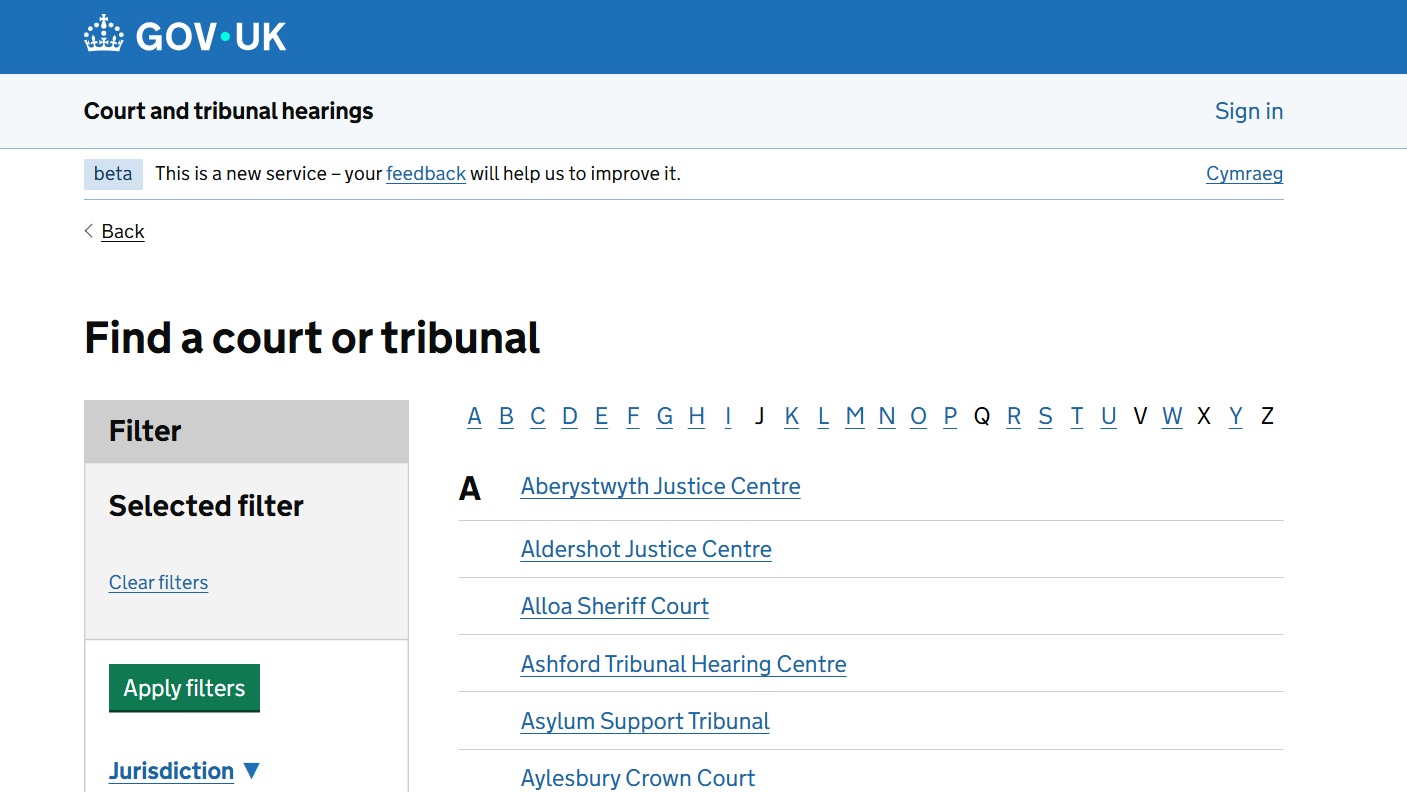
HMCTS has launched an update to its Courts and Tribunal Hearings (CaTH) service which provides access to a greater range of hearing lists. By accessing the Find a court or tribunal page and then selecting the desired court from the list, you are presented with a page showing the lists available for that particular court. See the examples below for the Weymouth Combined Court
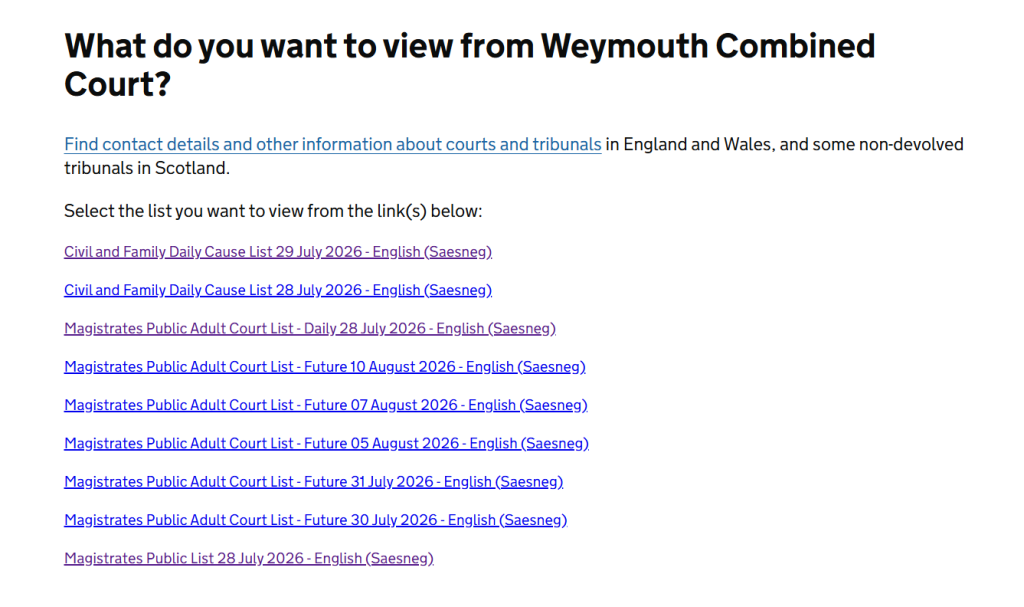
You will see that, for the Magistrates Court, there are two lists for 28th July. The Magistrates Public List and the Magistrates Public Adult Court List. The Magistrates Courts still operate two separate listing systems - Libra - an older legacy system, and Common Platform (CP) - the newer system. CP went live in all magistrates courts in August 2023, however a significant number of cases remain on the legacy Libra system. For more details of Common Platform history - see Common Platform: a modern digital case management system for the criminal justice system.
The Magistrates Public Adult Court List is the Libra listing of cases - which includes basic information such as Court, Time, Defendants name and Case Number and whether there are any reporting restrictions in place. The Magistrates Public List is the Common Platform listing which includes additional information including the alleged offence, the prosecutor and the type of hearing. Although, confusingly, when you click on the link to the actual list, BOTH lists are headed "Magistrates Public List for Weymouth Combined Court"! despite being two different and separate lists for the same Court.
So to find out what cases are being heard at a Magistrates Court it is necessary to look at (usually) two separate lists - the Libra list and the Common Platform list.
But there is another twist! The CaTH wesbite deals with reporting restrictions by simply stating below an entry that there are "Press/reporting restrictions" for a particular case. However the nature of the reporting restriction is not shown on the CaTH lists. For this information you need to refer to the Courtel / Courtserve listings. Courtserve is a free public service which has a contract with HMCTS to publish court lists. Professional court users can access a paid service to get lists from Courtel. But there is also a free public service which any member of the public can access after having created a free Courtel account.
The Magistrates Courts lists published by Courtel on the Courtserve system provide details of the actual Press/reporting restriction that applies to a particular case, whether that is because of the nature of the case where automatic reporting restrictions apply, or whether a court has issued an order or direction restricting the information that can be published about a particular case. [There is, however, a glitch in the Courtserve processing, which means that Courtserve will remove from their listings details of the alleged offence whenever a case has a reporting restriction in place].
So, some big steps forward with Court listings, together with the need to access more than one list and to also access the Courtserve system to obtain details of the reporting restrictions.
How about Open Justice in practice at a Court?
I had picked out a case in the Weymouth County Court that I was interested in observing. It was listed as a Part 8 Case Management Hearing (Civil) in front of District Judge Lacey. But it was the applicant that caught my attention - The Child Maintenance Service on behalf of the Secretary of State for Work [and Pensions].
I had just read an article regarding the allegations that this branch of the Department for Work and Pensions had been accused of pursuing people relentlessly despite rulings in Tribunals and Courts in favour of the complainant, and that its computer system was unreliable and issues with the computer systems had been likened to the Post Office Horizon scandal. So I was intrigued when a case related to this branch of the DwP came up in the Weymouth County Court.
Attending Court 3 in the Weymouth Combined Court centre, I notice one person sitting waiting outside that court. He asked me whether I was the Respondent in the case, and I replied that I was not but was a public observer. I asked if he was a representative for the applicant and he confirmed that he was.
Just before the Court Usher arrived I asked this person whether he had any objection to me observing the hearing. He said that, yes, he did and that it was a private hearing. I expressed surprise as it had not been listed a private hearing and appeared to be a straight forward Part 8 application in the County Court which would ordinarily be a public hearing. We discussed the Civil Procedure Rule - rule 39.2 - which would usually apply.
At this point this person gathered up his belongings and went in to one of the consulting rooms to make a phone call. The Court Usher came out of Court 3 and as he approached I advised the Usher that I wished to observe the hearing and could he ask the Judge if that was OK. The Usher asked the representative for the Child Maintenance Service if he was ready - and he asked for a couple of minutes and returned to his room and his phone call.
A few minutes later he finished his call and indicated to the Usher that he was ready. The Usher told us that the Judge had said that it was a public Court. Turning to me the representative from the Child Maintenance Service said that, it was nothing personal, but that he had to address the Judge and that it was his job to do this. I just smiled and followed him in to the Courtroom.
District Judge Lacey welcomed us both in to Court 3 and clearly knew us both, addressing us both by name. He started by saying that it was public hearing and that the Open Justice principles applied. The representative from the Child Maintenance Service referred the Judge to rule 39.2(3)(c) and (d) - confidential information and the interests of a child - and asked that the hearing be held in private. The Judge said that he had had the opportunity to read through the papers for the case. If a specific matter arose which he considered should not be disclosed, then he was sure that Mr Bell would agree to leave the Courtroom whilst that matter was dealt with. I smiled at the Judge and nodded my consent.
As the respondent in the case had not attended it was a fairly short hearing with the Judge agreeing to issue the order sought and spending a little time agreeing the costs requested (which he appeared to think were quite modest). He asked the representative from the Child Maintenance Service if he would draft the order and was provided with a previously typed up draft of the order sought.
The Judge commented as he announced the making of the order that this might "wake-up" the respondent, who had not engaged in the proceedings and had not attended.
After just 16 minutes we both left Court 3 with Judge Lacey wishing us both a good day.
Open Justice concern
So, what is my Open Justice concern here?
It was the statement by the representative of the Child Maintenance Service that the hearing was a private hearing, when this was quite clearly not the case. For the hearing to be a private hearing, the applicant should have made an application to the Court ahead of the hearing asking, pursuant to rule 39.2 that, for the reasons given, the Court should hold all or part of the hearing in private, that is with the public excluded from all or part of the hearing. That should usually be done on notice, so that the Press can be notified and be able to make representations regarding that matter before the Court decides whether or not to grant an application for all or part of the hearing to be held in private.
The representative of the Child Maintenance Service knew fully well that no such application had been made, and that therefore, unless the Court ordered otherwise, the hearing was a public hearing.
The attempt to dissuade me from trying to observe the hearing failed because I have studied the rules and read up about what process should be followed. and, because I had observed quite a few times in front of Judge Lacey, I was more relaxed about going in to his Courtroom and asking to be allowed to observe.
The representative from the Child Maintenance Service owes a duty to the Court when acting as an officer of the Court (as all advocates appearing in Court are considered to be officers of the Court) to act in an ethical way at all times. The action of attempting to dissuade a member of the public from observing a public hearing by incorrectly stating that the hearing was a private hearing when they knew that this was not true, is not something that a representative of the Child Maintenance Service, who is likely to be a qualified solicitor or a barrister, should be doing.
Of course, it could be the case that the representative from the Child Maintenance Service genuinely believed that the hearing was a private hearing when he told me this. But I would suggest that the onus is on the professional to ensure that the information that he is giving to a member of the public is accurate, and if he was in any way, unsure, he should have qualified his statement accordingly.
And so to the Magistrates Court
Both of the two Magistrates Courts at the Weymouth Combined Court centre were still sitting when I left Court 3 and the County Court area. I first went in to observe in Court 2 where a bench of three magistrates were hearing a case with a male defendant in the Dock. The case was just concluding and the Chair of the bench was advising the Defendant that he was being granted bail to appear at Poole Magistrates Court at 10:00 a.m. on 9 March 2027.
There was some discussion that the notice of that hearing may say that the hearing was at Poole Magistrates Court sitting at Southampton, but the Defendant should ignore that and assume that his hearing would be at Poole Magistrates Court.
The Legal Advisor to the bench explained that the latest information was that Poole Magistrates Court, which was currently closed for urgent repairs, was expected to reopen in mid-December 2026.
I observed a couple of cases in Court 2 before following the Usher (whom I know well) out of the Court to ask whether the case of De'Ath (which I had observed before) had been heard. The Usher helped me to find the entry on the hearing lists and directed me to Court 1.
As I entered the "air-lock" areas in Court 1 (between the doors between the waiting area and the public seating area) the Court Usher who was someone that I had not met before, pointed to a notice which said "ALL mobile phone MUST be switched off" and asked me to turn off my mobile phone. I advised that my phone was switched to silent but I had not turned it off. The Usher insisted that I MUST turn off my phone before entering the public seating area. I asked her to double check with her colleagues as I had previously had this discussion with her colleagues and they had agreed that I could use both my mobile phone and my laptop to record notes of the hearing. The Usher asked me to wait in the "air-lock" area until she had consulted her colleagues, which I did.
A few minutes later she returned and said that it was OK for me to have my phone switched on so long as I did not record anything. I assured her that I would not be using the phone to record anything but just to make notes and look up the hearing lists, and proceeded in to the public seating area.
I watched the remaining cases in Court 1 ending with the application to vary a restraining order against Mr De'Ath which the bench agreed to vary as requested by his former partner.
As the business of the Court had ended I took the opportunity to speak with the new Usher and draw her attention to the HMCTS publication How you can attend or access courts or tribunals - a guide for members of the public which includes a paragraph regarding the use of mobile phones and laptops in the Court.
I was a little concerned that, although she was grateful for the reference to the publication and thanked me for the information, she insisted that the Court Ushers would continue to ask members of the public to switch off their mobile phones as that was the easiest way to ensure that they were not going to record anything (which appeared to be the Ushers' main concern).
Apart from the fact that the Court Ushers do not have the right to insist that mobile phones are turned off, as opposed to being switched to silent mode, and that such requests are a clear impediment to the public's right to use their mobile phone to make notes of a hearing and therefore an impediment to Open Justice, the reason given - which is to prevent a recording of a hearing being made - does not really stand up to scrutiny.
If I were someone who was determined to break the rule on recording a hearing (and risk being found in contempt of Court!), then, when asked, "had I switched off my mobile phone?" I could just answer Yes, I have, when in fact the phone was still switched on and in my pocket. If I am prepared to risk the consequences of breaking the recording ban, then it is highly likely that I would be prepared to lie to an Usher to cover up my intentions [I hasten to add that this is not something that I would do myself, nor would I condone such action].
But the point I am trying to make is that the so-called reason for insisting (against the guidance from HMCTS itself) that mobile phones MUST be switched off does not make sense, and that HMCTS staff, instead of trying to enforce such a ban should instead be thinking how they could encourage the public to observe and make notes from the public seats in a Court room. They should be promoting Open Justice, not acting to curtail it.